Authentication
Can you prove access?
A provider or credential establishes the way in.
GAMA Identity / Shared platform infrastructure
One fundamental question.
A shared answer to who is here.

Warm nucleus The person
Aqua pathways The infrastructure
The architecture changes.
The person remains.
01 / Origin
A list. A memory. A routine. A little shop. Each product has its own world. Underneath, each eventually needs to know who arrived.
Rebuilding accounts, credentials and session handling for every application creates islands. The platform needed a more durable starting point.
Another account.
Another session.
The same human.

The foundational problem
Products should be free to feel different. The person should not have to become a new technical identity every time the product changes.
02 / Experiment
An authentication provider verifies a credential. GAMA resolves that verified relationship to a person inside the platform.
Apple, Google and email/password can be ways in. The principal is the answer that remains after the door has closed.

Authentication
A provider or credential establishes the way in.
Identity
The GAMA principal is the platform’s durable answer.
An interactive architectural example
All three methods are explicitly linked to this fictional account. Selecting a door illustrates recognition; it does not sign you in.
Same fictional principal
EXAMPLE-HUMANA verified Apple provider relationship resolves to this example Human.
Selected route: AppleAn unlinked provider is a different case. Email equality alone never establishes this relationship.
Principal / HumanIdentity
An email is credential or provider metadata. The current HumanIdentity model has its own identifier and lifecycle.
Returning through an established provider relationship resolves to that Human. Adding a new route requires an explicit link to the authenticated account.
The door can change. The person should not.

03 / System
The current service models a HumanIdentity independently of credentials and sessions. Provider relationships point to that identity. Applications can build on the result.
Recognition, session continuity and permission are distinct responsibilities. Keeping them separate is what makes the whole system understandable.

A readable architecture / Not an operational topology
One human arrives
Apple · Google · Email
Principal + session
Separate permission checks
An integrated application

Renewable sessions
The service exchanges valid renewal state for fresh access and rotated renewal state. The principal stays the same.
IdentityKit can restore a locally saved session, validate it with the server, and renew it when appropriate. Restoring local state alone does not prove current validity.
Expiry and revocation still matter. Continuity is controlled, not permanent.
Shared Apple client / GAMAIdentityKit
The Swift actor owns shared authentication behaviour, in-memory state and Keychain session persistence. Validation, renewable access, provider linking and logout have one reusable home.
Applications still choose their integration and account interface. The kit is shared logic; it does not make sessions automatically portable between apps.


Two different questions
IdentityWhich Human is authenticated?
EntitlementDoes that Human have this product access?
The platform evaluates product, membership and entitlement state separately from the Human’s identity. A valid sign-in alone does not grant workforce or platform authority.
The inspected Grocery NEXT implementation keeps principal identity, purchase account mapping and transaction environment in separate records. A purchase is evidence for product access; it is not the person’s identity.
This describes the current Grocery NEXT source. It is not a claim that every shipped product has moved to this model.
Real interface / Coco the Llama
Three sign-in routes. One familiar shop. Recovery is part of the same account experience.
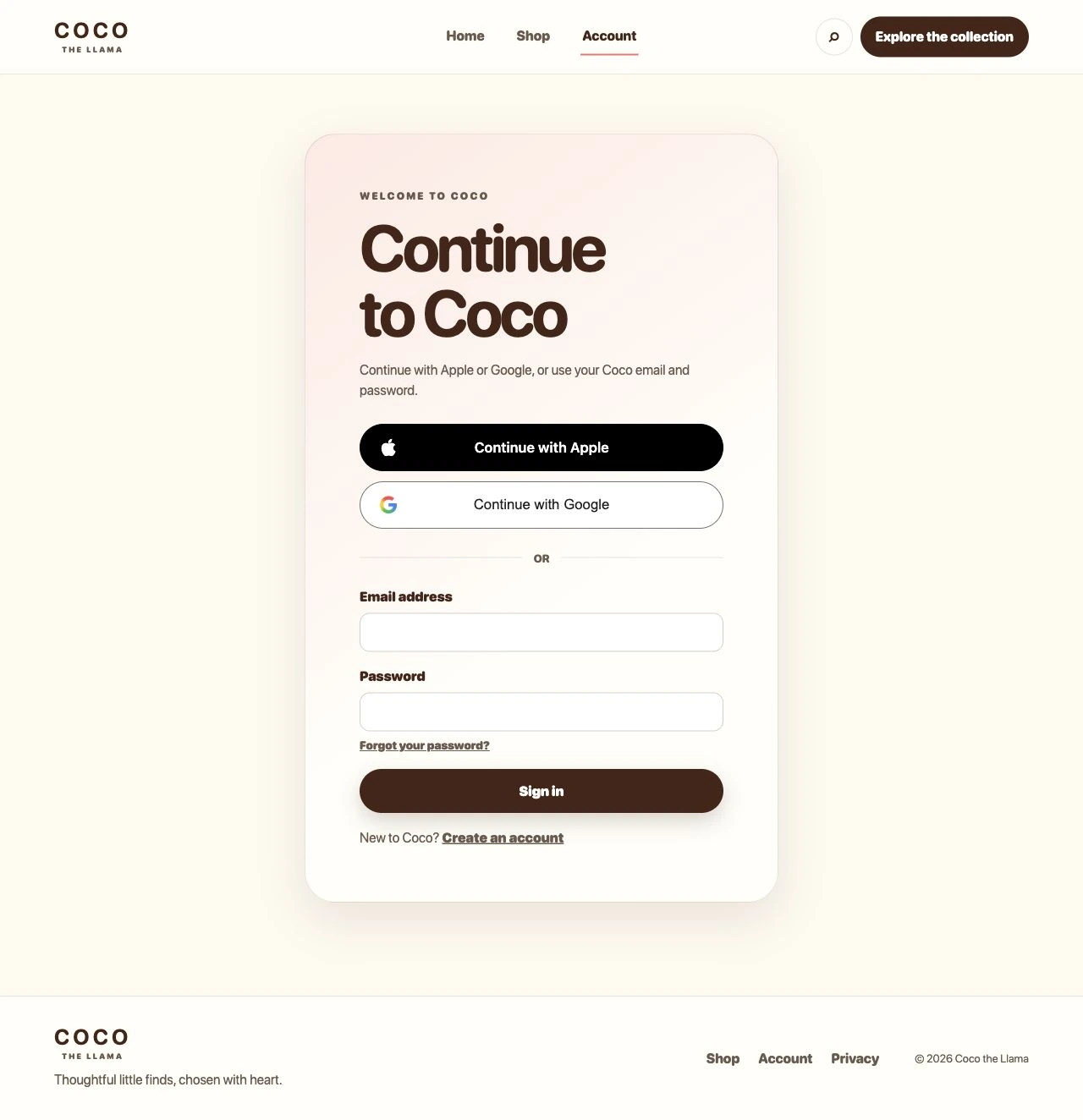
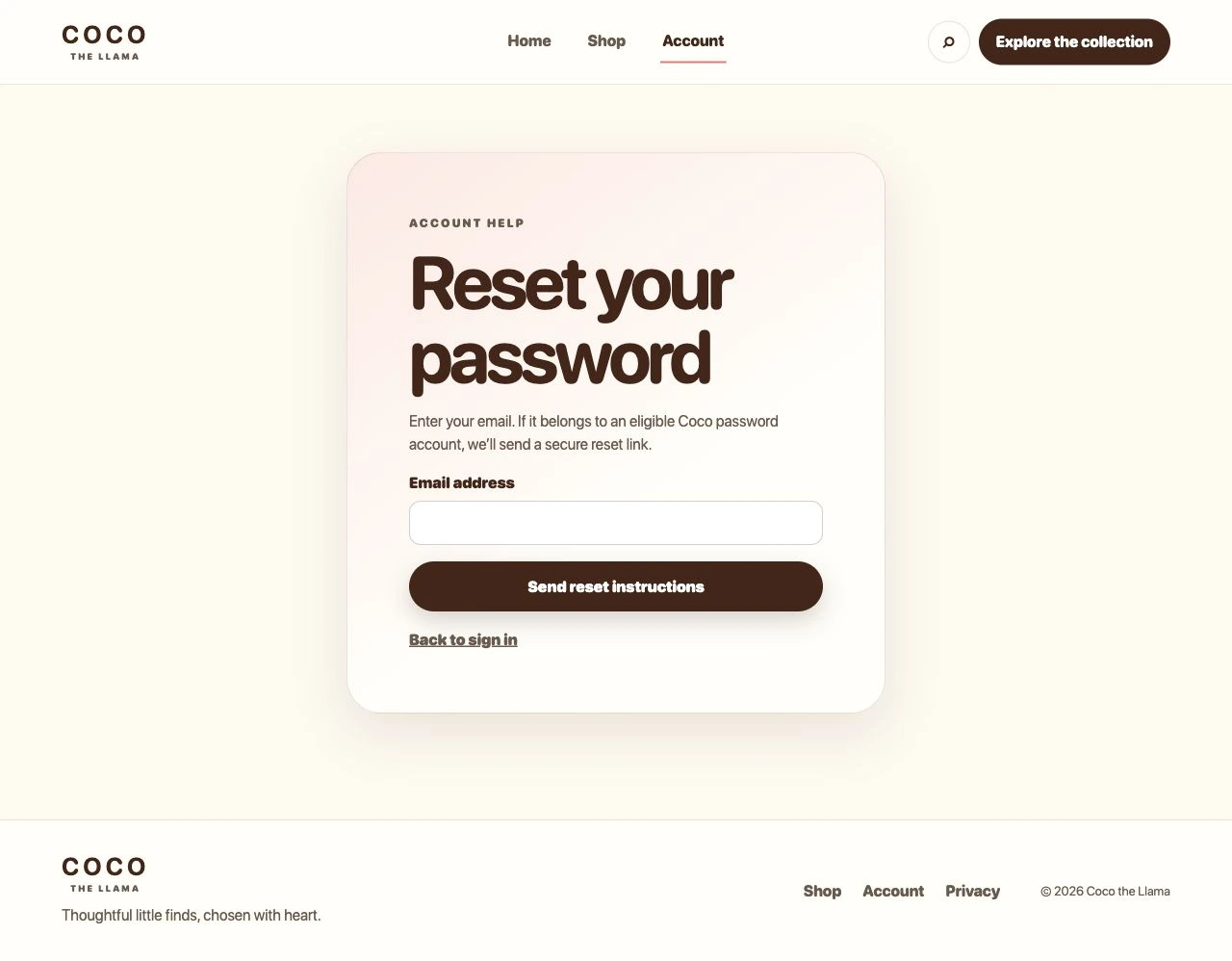
Implementation reality / Reviewed 8 October 2026
The four worlds illustrate the reason for GAMA Identity. They do not claim that all four already share one automatic sign-in. Each integration maintains its own session and access boundary.
04 / Problems
A successful sign-in is only the beginning. Matching emails, expired sessions, changing response contracts and environment boundaries all need explicit answers.
Four failure studies, grounded in current regression tests and documented client fixes. Conceptual scenes show the lesson, not production account data.

Failure 01
The same email can arrive through different provider subjects. Matching the visible label is not enough to establish that two authenticated identities belong together.
Link a verified method to an authenticated principal. Never merge on email text alone.
Service regression tests cover Apple, Google and password-account collisions, plus explicit linking conflicts.

Failure 02
A login that works now can fail later. An expired access session and a revoked renewal credential are different states, with different paths forward.
Renew valid continuity. Respect expiry and revocation. Preserve retryable network failures.
Session tests cover rotation, expiry, revocation and reuse rejection. SDK tests cover shared renewal after concurrent unauthorised responses.

Failure 03
A shared service can still drift from its clients. Earlier IdentityKit releases needed fixes for production registration and login response contracts.
Centralise response mapping and test the contract at the shared boundary.
IdentityKit 1.0.2 and 1.0.3 document the concrete compatibility fixes. Four passports is the metaphor for duplicated client interpretation.

Failure 04
A test configuration can look deceptively like a live one. Provider audiences, trusted app destinations and persistence configuration must agree before a flow can be trusted.
Make the environment explicit. Reject incomplete or incompatible configuration.
Configuration tests enforce complete provider setup, allowed client identifiers, trusted HTTPS app origins and required database configuration. This is a tested failure boundary, not a claimed production incident.
05 / Solutions
A stable principal. Explicit provider relationships. Renewable sessions. Reusable client behaviour. Product access checked on its own terms.
The infrastructure carries that complexity so the person can get on with the product.
A HumanIdentity exists independently of its credentials and sessions.
Verified provider links connect to an authenticated Human; email matching is not a shortcut.
Valid renewal state rotates. Expired, invalid and revoked states have explicit outcomes.
IdentityKit brings common lifecycle behaviour to Apple integrations.
Provider configuration, trusted app destinations and product access remain deliberate.
The identity foundation works underneath the app’s personality.

Ordinary human realities
The service coordinates email verification and password recovery. Reset challenges are time limited and consumed; replacing a password revokes the Human’s sessions.
A returning device must restore and validate its session, or ask the person to authenticate again. Reinstallation alone is not proof of identity.
Leaving matters, too. IdentityKit logout ends the remote session before clearing local state. Local-only removal is a separate operation.

The emotional north star
A person returns. A valid session continues. The right access rules apply.
Nothing dramatic happens.
That is the work.
HumanIdentity, federated authentication and linking, session lifecycle, email recovery, PostgreSQL adapters, provider configuration and the current IdentityKit source.
40 selected service tests passed during this specimen audit: provider identity collisions, explicit links, session rotation and configuration boundaries. SDK renewal and contract tests were inspected separately.
Two unmodified-content captures from Coco’s live public account interface. They demonstrate available screens, not a completed authenticated session or a cross-product login.
Conceptual routes and the interactive account are illustrative. No private identifiers, credentials, tokens or database records are shown. Source and artwork provenance accompany this specimen.
06 / Evolution
Seven architectural mutations describe the direction of the system. These are conceptual stages, rather than a dated release history. The shared foundation is live; adoption is integration by integration.

Separate gates
Each product begins with its own answer.
Repeated account and session behaviour creates islands.
A central interchange
One foundation becomes reusable.
Products can consume a shared identity service.
One constant nucleus
The person outlasts the credential.
HumanIdentity is independent of email and provider metadata.
A renewable bridge
Continuity becomes a responsibility.
Access can renew within its lifetime and end predictably.
One reusable module
Solve common client behaviour once.
IdentityKit shares persistence, validation, renewal and provider operations.
Independent destination gates
Who you are and what you can use.
Identity supports product access without becoming the access rule.
A coherent ecosystem

Different products. One durable answer.
The direction: shared recognition across integrated products, with explicit sessions and permissions.
GAMA Identity / Specimen 005 / Live & evolving
Identity should not be another thing
the person has to manage.