Exact variant / Item Actions
This size.
This stock.
- Change Price
- Put Away / Move
- Increase Stock
- AI Photos & Coco Details
- Item / Product Details
- Label for the exact SKU
Specimen 004 / Children’s fashion commerce system
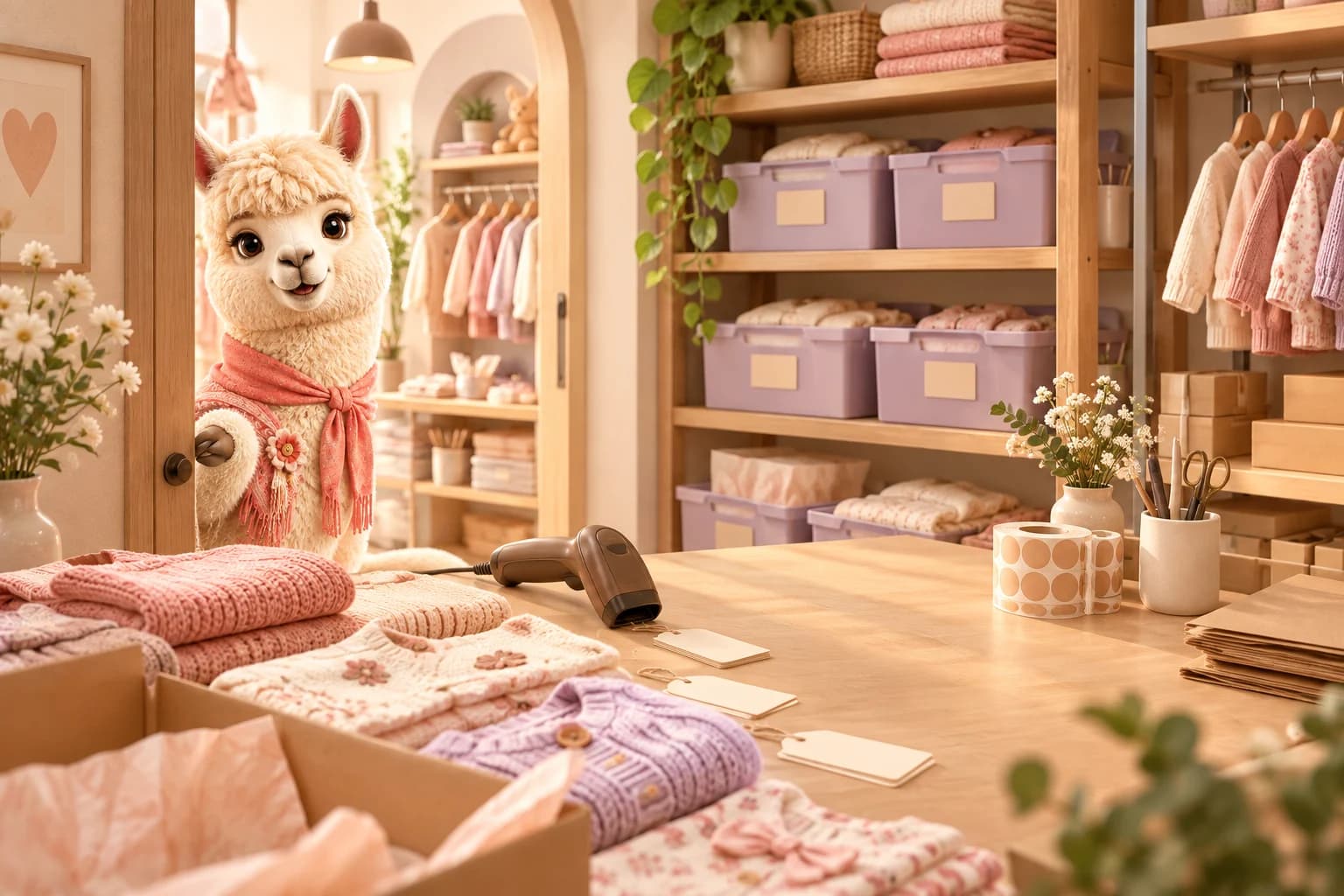
A lovely little shop.
A surprisingly serious system underneath.

Small shop.
Serious system.
How much operational power can a very small retail business have without becoming operationally heavy?
Customer website + native Backstage application01 / Origin
One lovely piece. A photograph, a size, a price. Then stock, a place on a shelf, a listing and a way to find it again.
A small shop is still a real operation. The product is small. The lifecycle is not.
The product is small.
The lifecycle is not.

02 / Experiment
Start with the thing in your hands. Photograph it. Add the facts only the shopkeeper knows. Let software help with the repetitive catalogue work.
The experiment: give a small business more operational power without giving it more operational weight.

Capture the physical item and choose its broad category.
Brand, condition and the relevant colour. Optional Product Tags add context.
Set the size and quantity. Each sellable variant gets its own identity.
Check suggested naming, classification and content before applying it.
AI handles repetition
Merchant facts stay authoritative. AI suggestions carry confidence and provenance, and the app can ask for confirmation.
Exact-image hashing and semantic candidate matching provide a duplicate checkpoint before another record joins the catalogue.
Legacy plain descriptions remain supported. Classification suggestions are validated before use; uncertainty can remain explicit.
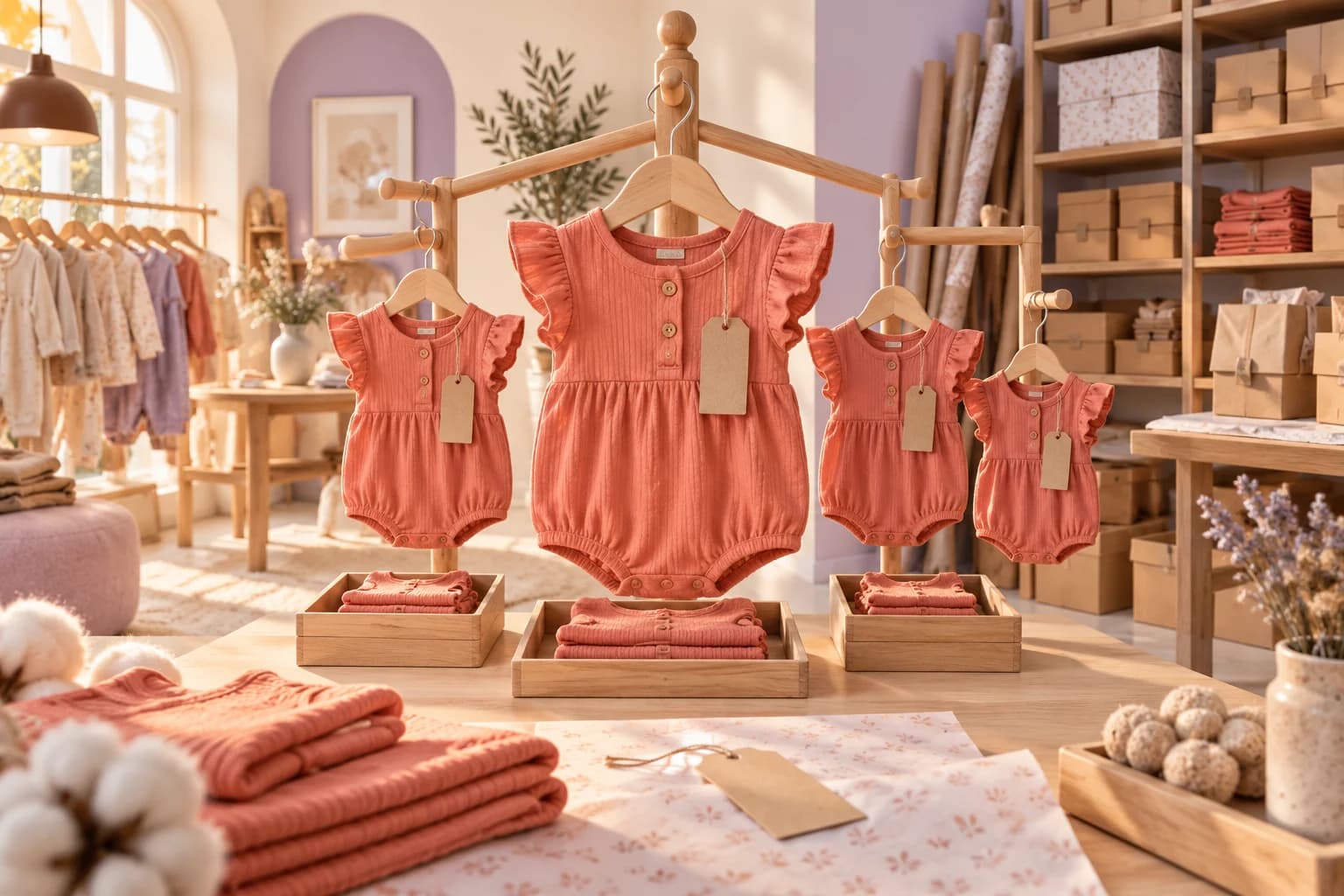
03 / System
Parents see something lovely in the right size. Backstage sees a product, exact variants, available stock and a physical home.
The two views belong to the same system. Complexity stays behind the curtain.
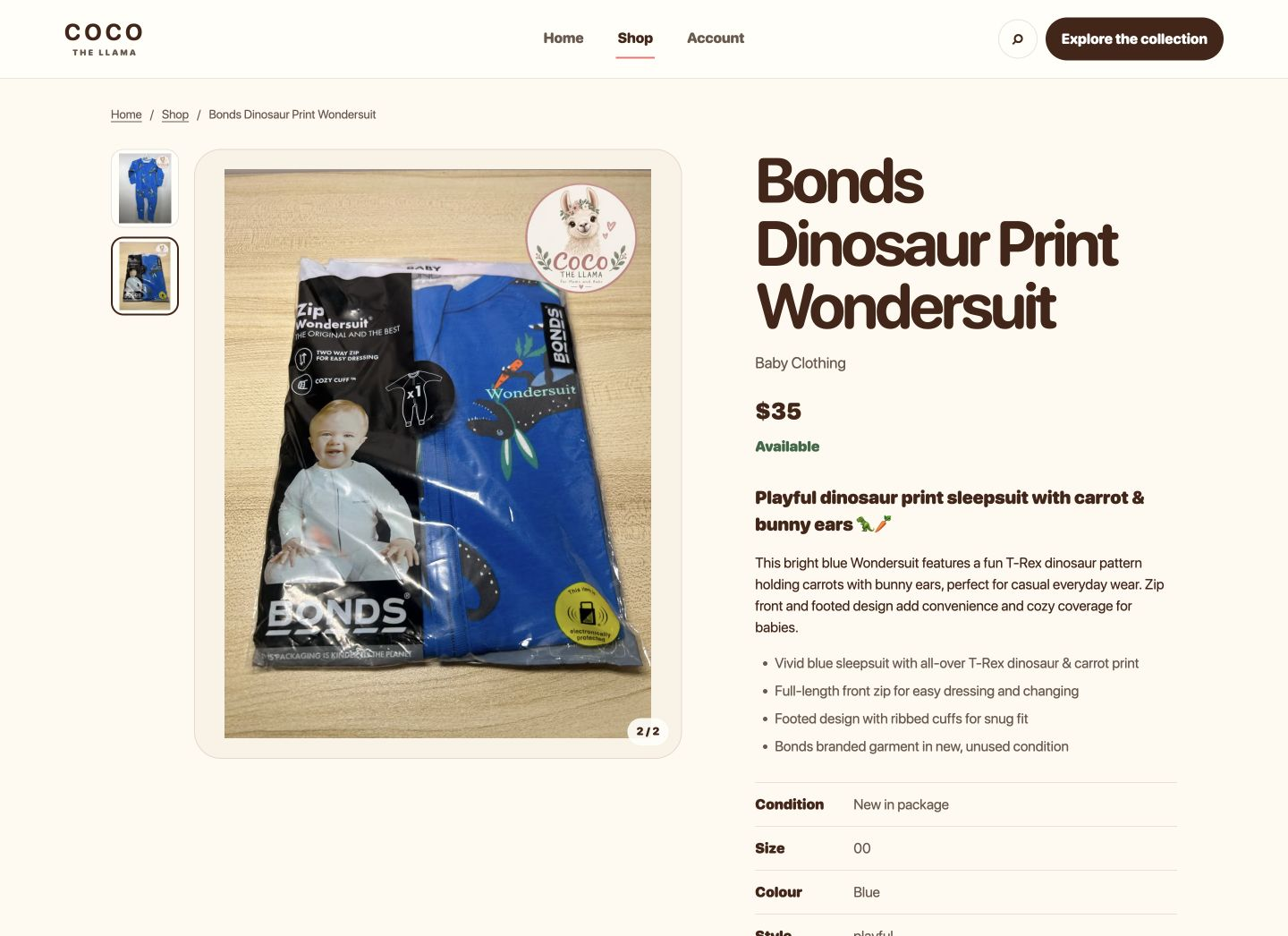
 Original product photograph
One product. Two realities.
$35 Available
A playful blue sleepsuit. Size 00. New in package. The useful details, without the stockroom.
See the real product ↗Public listing captured 8 October 2026. Price and availability can change.
Front stage / The customer website
Clear images, useful condition labels, a price and availability. The shop turns a rich product model into a simple decision.
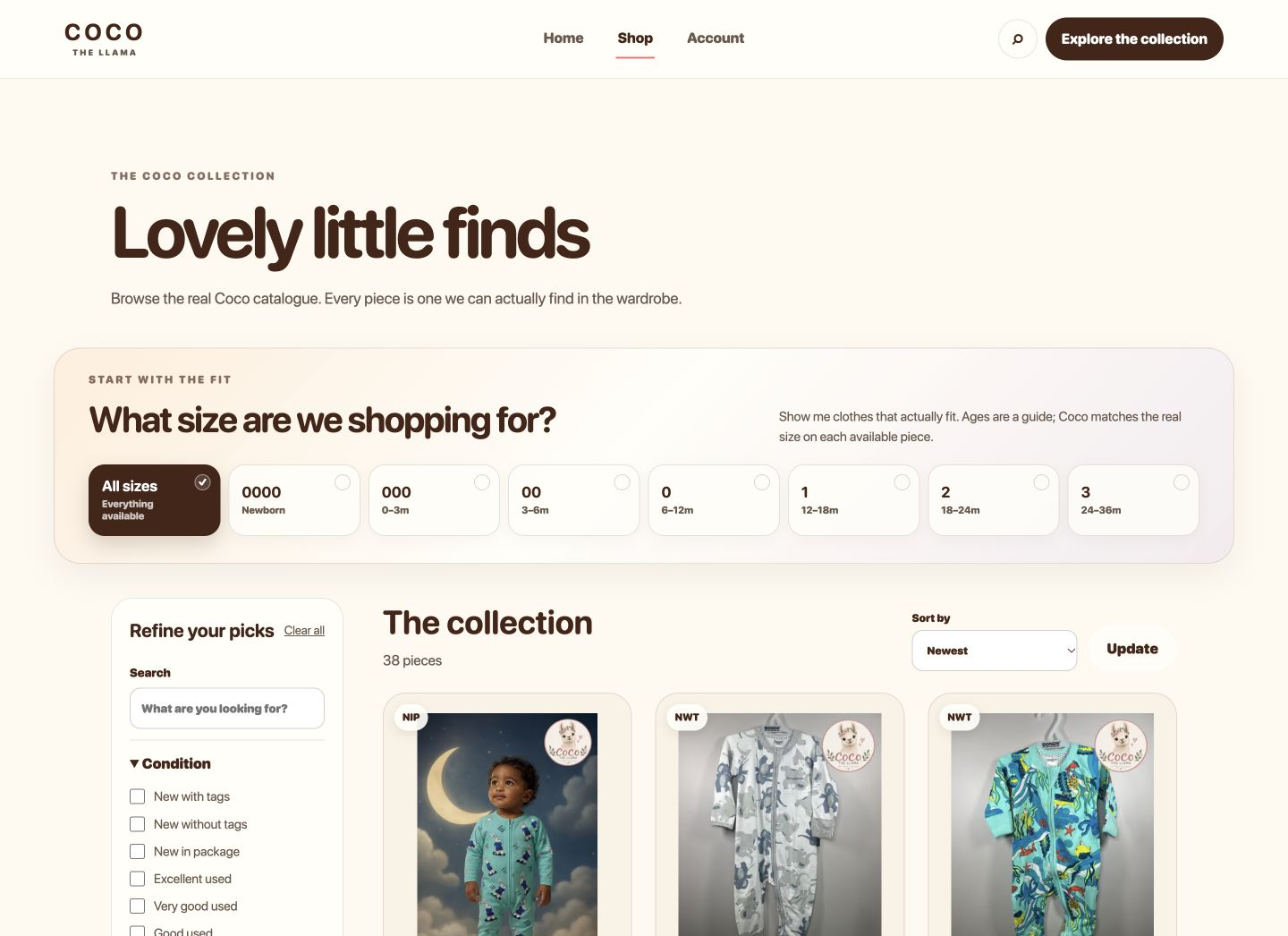
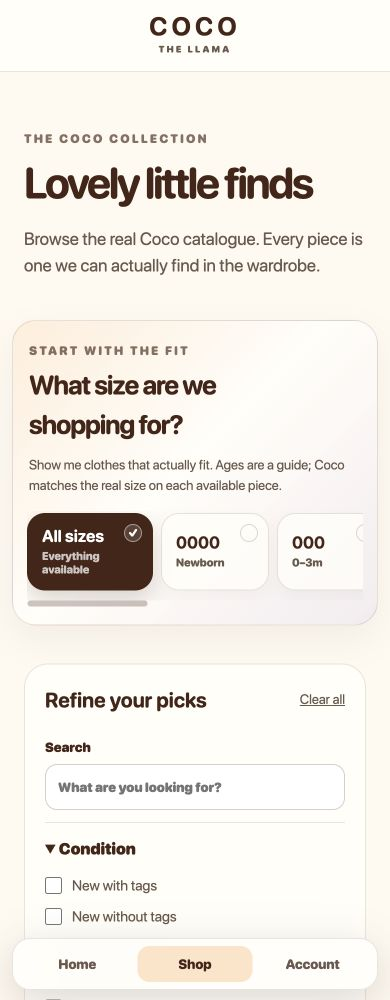
A little guidance
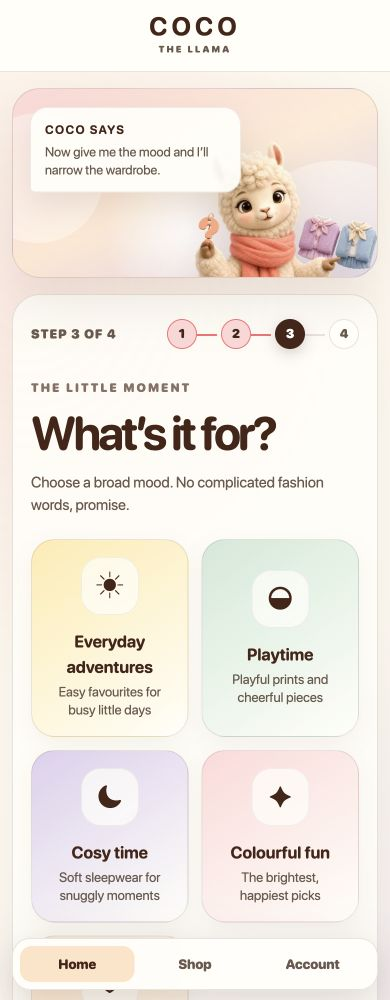
Help Me Choose asks four approachable questions: size, who it’s for, the little moment and colour.
When an exact match is scarce, it relaxes colour, then moment, then recipient. The chosen size stays fixed.
The machine knows more than the shopper needs to see.
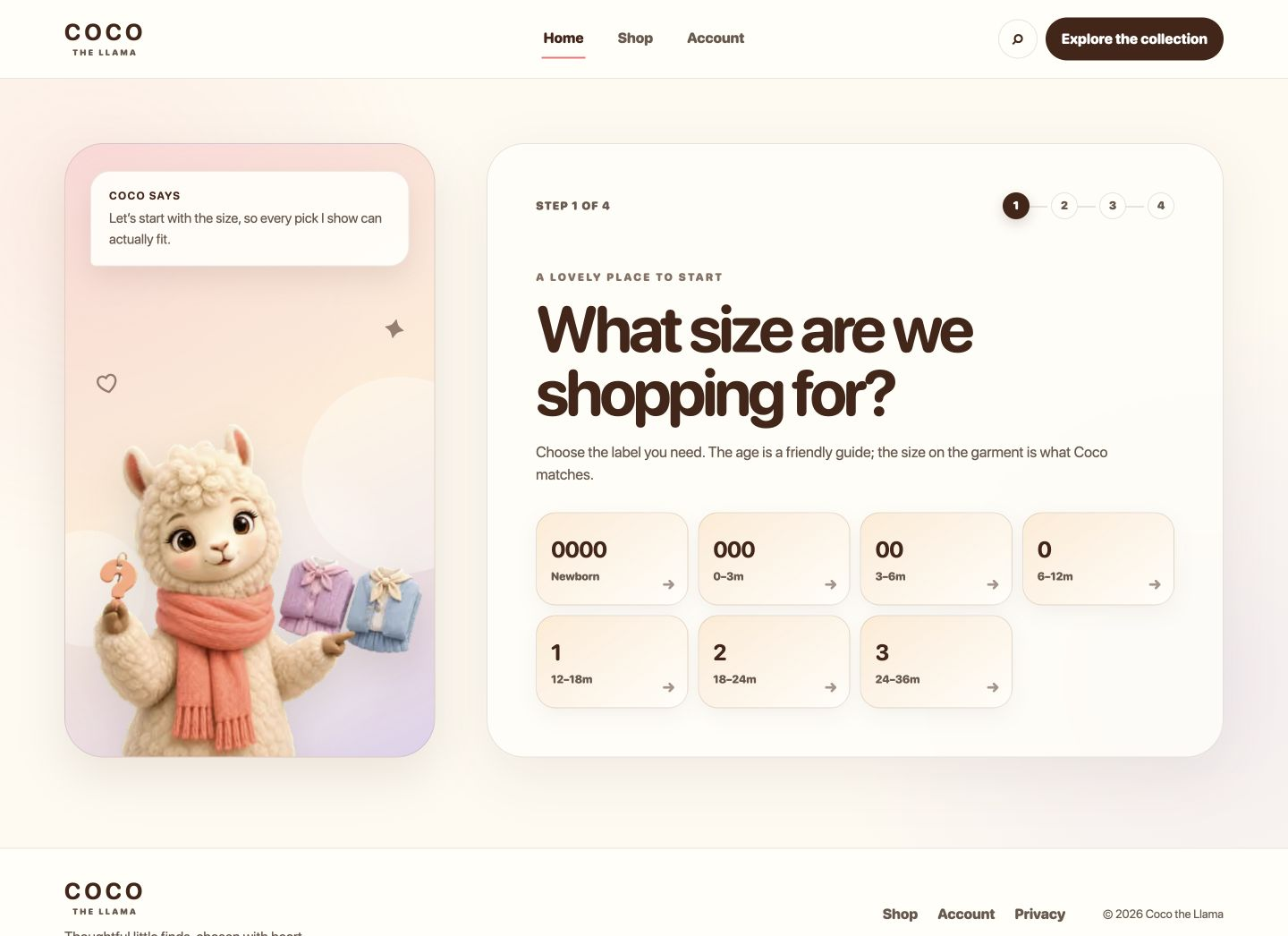

Discovery / Quiet intelligence
Title, brand, descriptions, tags, shopping facets and variant sizes and colours contribute to discovery. Existing legacy data still has a place.
Current size guides: 0000 = Newborn; 000 = 0–3m; 00 = 3–6m; 0 = 6–12m; 1 = 12–18m; 2 = 18–24m; 3 = 24–36m. Ages are a guide. Matching uses the actual available variant size.
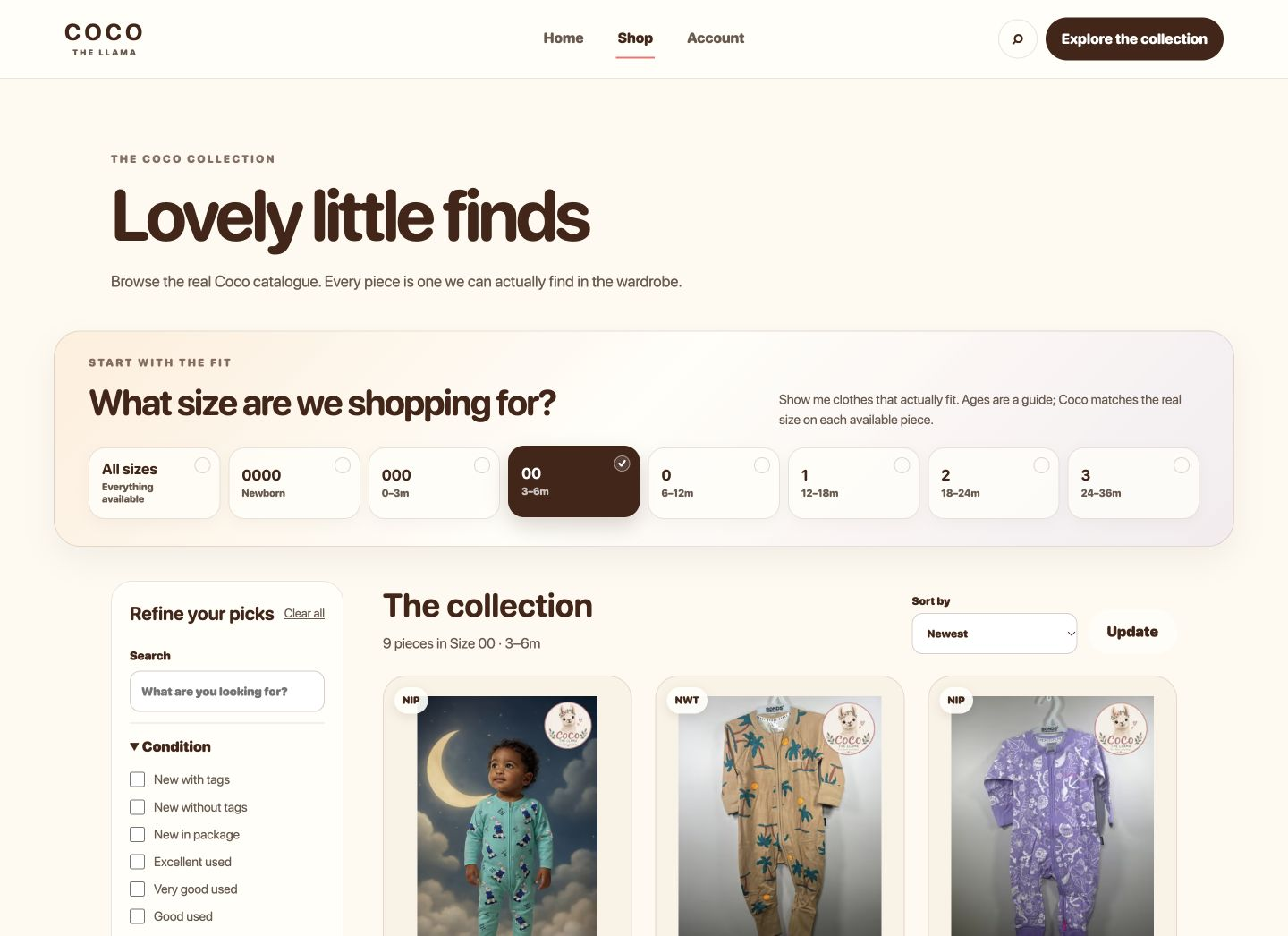
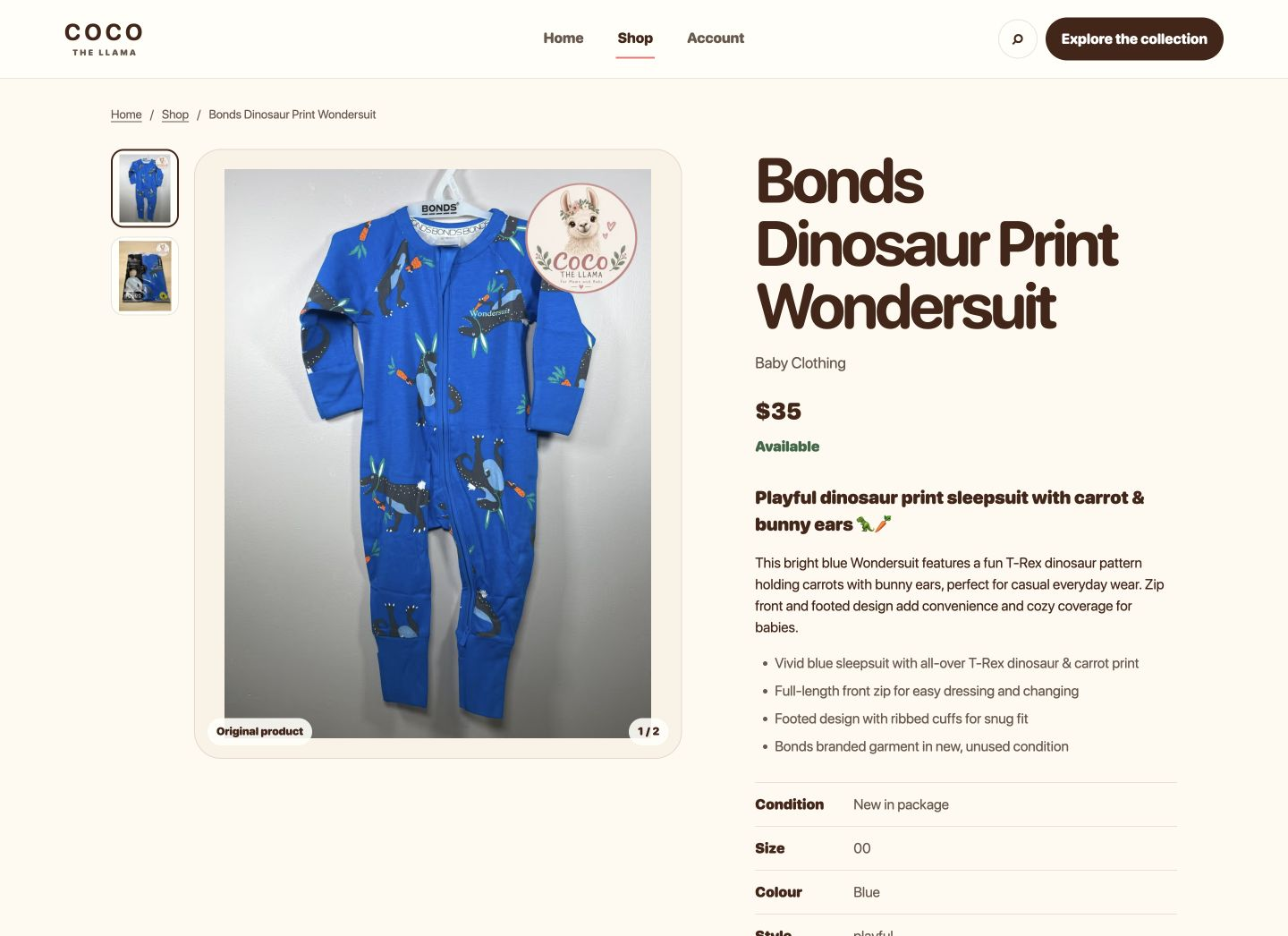
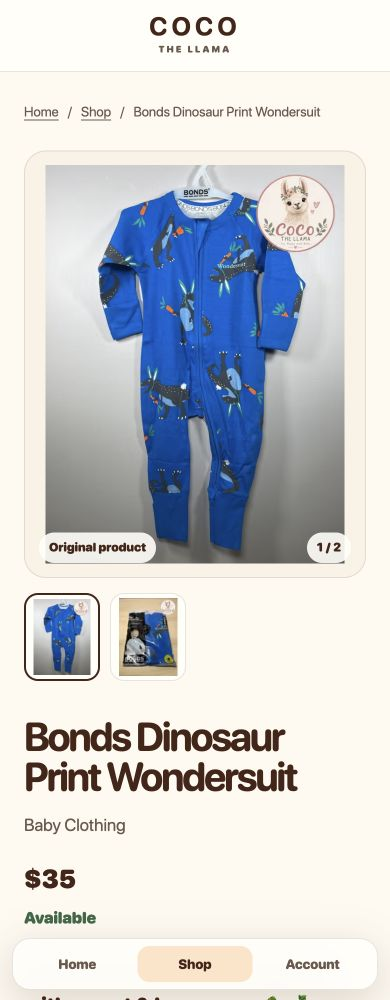
Original photography and additional gallery views help shoppers inspect the piece. Larger views stay one tap away.
Registration, sign-in, sign-out, email verification, password reset and persistent sessions are implemented through GAMA Identity. Apple and Google are available sign-in routes.
The navigation adapts to account state. The capture here shows public sign-in options; it does not show an authenticated session.
Read Coco’s privacy policy ↗
Still chapter 03 / Pull back the curtain
A small retail control system built around the object in your hands.
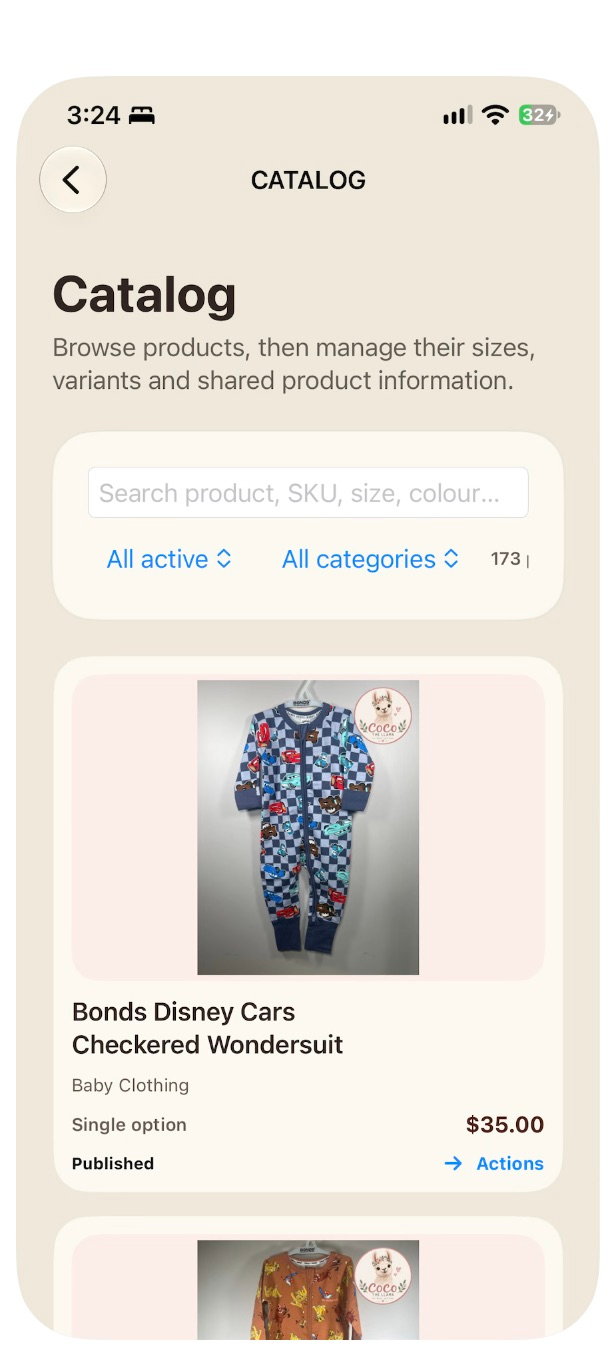
Native application / Catalog
Browse shared product records, then open the sizes, variants and actions behind each piece.
The native Catalog keeps publication state and product-level information together. Find & Scan is the faster route when an exact item is already in hand.
From arrival to the next home
The full retail lifecycle. The live website currently supports browsing, without online checkout. The backend has order and configured shipping-rate support; automatic postage-label purchase is a future direction.
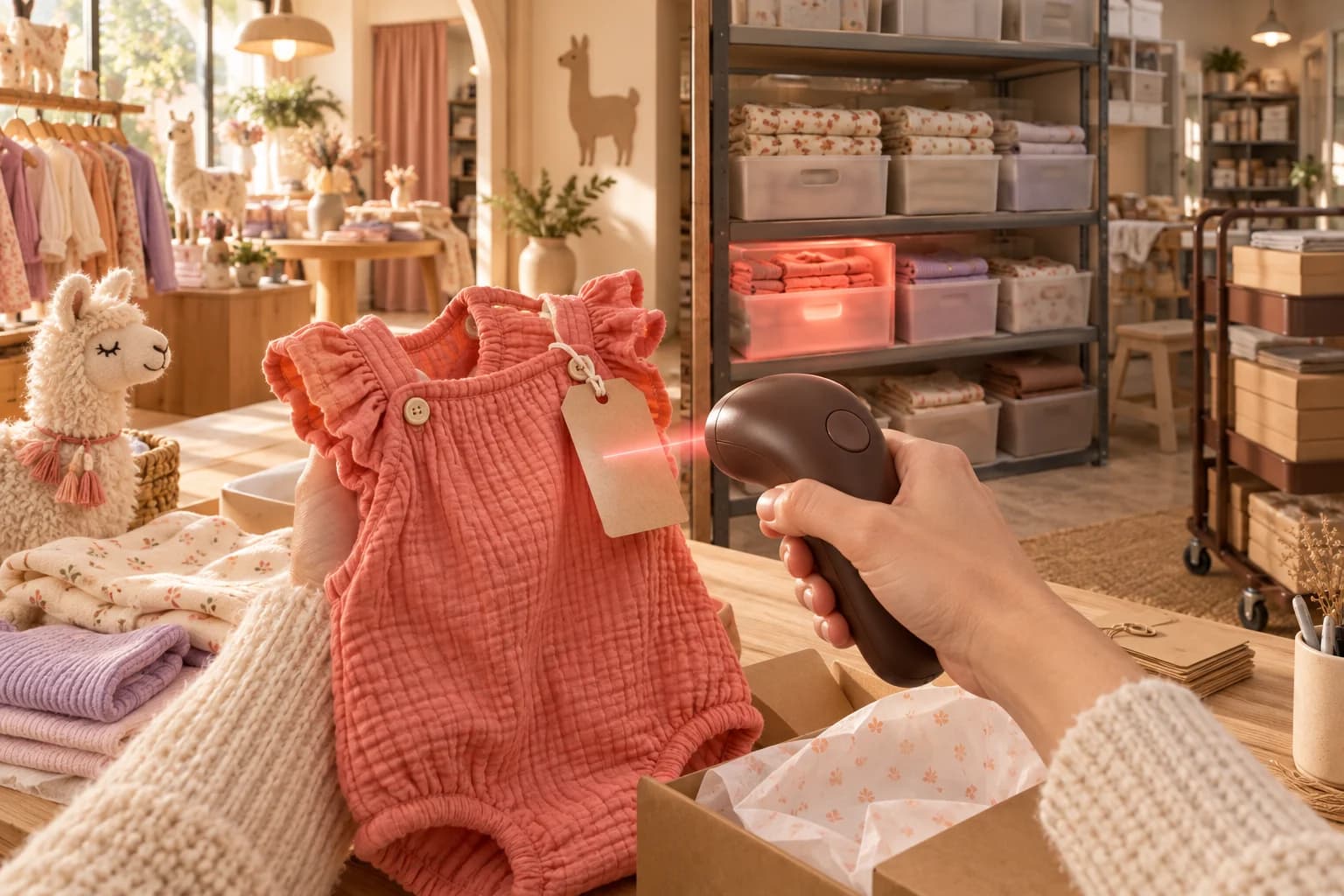
Find & Scan
Scan the QR label, or search by product, SKU, size or colour. Resolve an exact variant and open Item Actions.
The idle search surface leaves the catalogue out of the way. The task begins with the item you are holding.
Exact variant / Item Actions
Shared record / Product Actions
Publish and Unpublish act on the whole product, including when opened from an item. A SKU label identifies inventory; it is not a postage label.
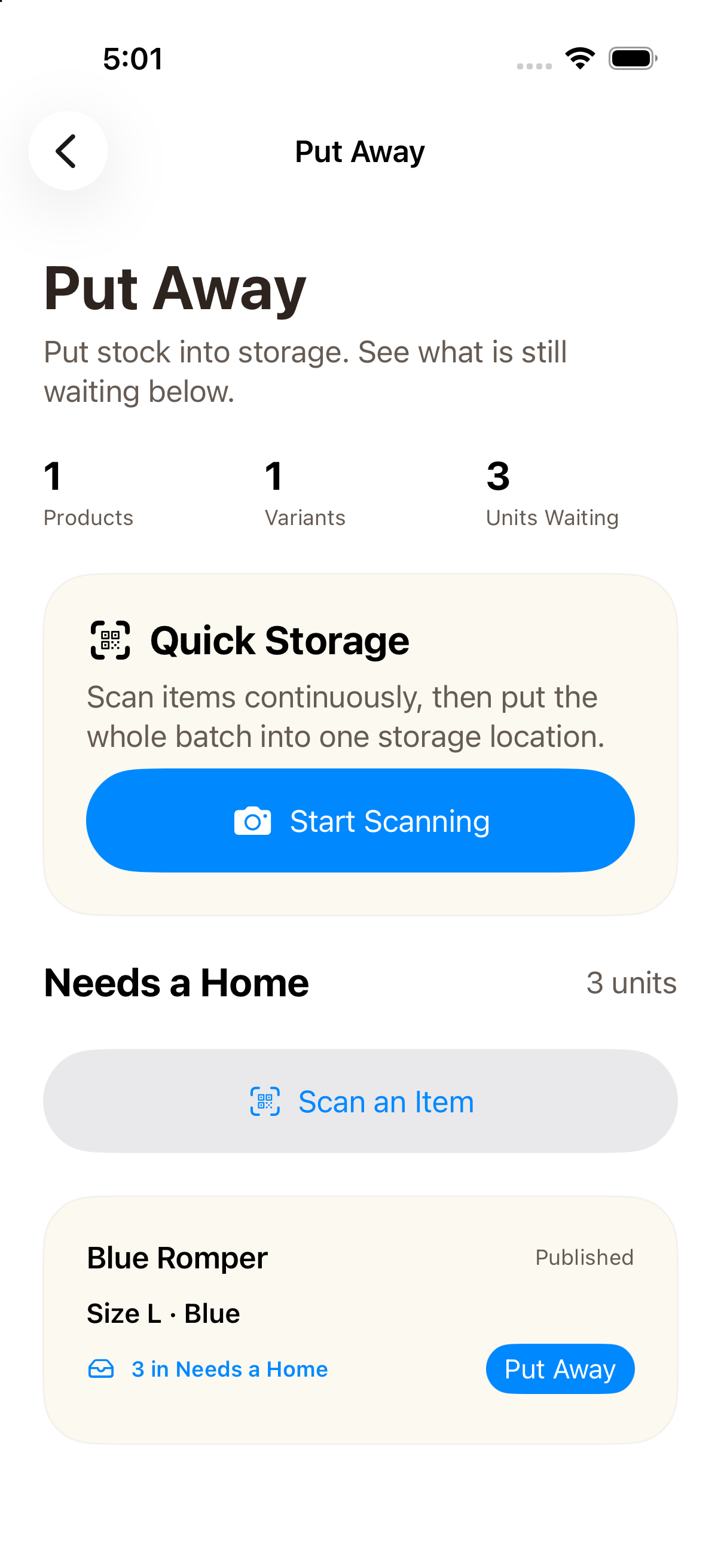
Quick Storage / Put Away
“Needs a Home” shows what is waiting. Quick Storage helps the operator finish the work.
A small sound. Less uncertainty.
An ambiguous response keeps the same operation identity and payload for retry. The workflow guards against moving the same stock twice. Rejected and changed-stock cases stay visible before confirmation.

AI Photos / Visual merchandising
Flat Lay, Close Up, Mannequin, Family Vibes, Special Occasion, Studio Product, In Motion and Custom Styled are the current selectable scenes.
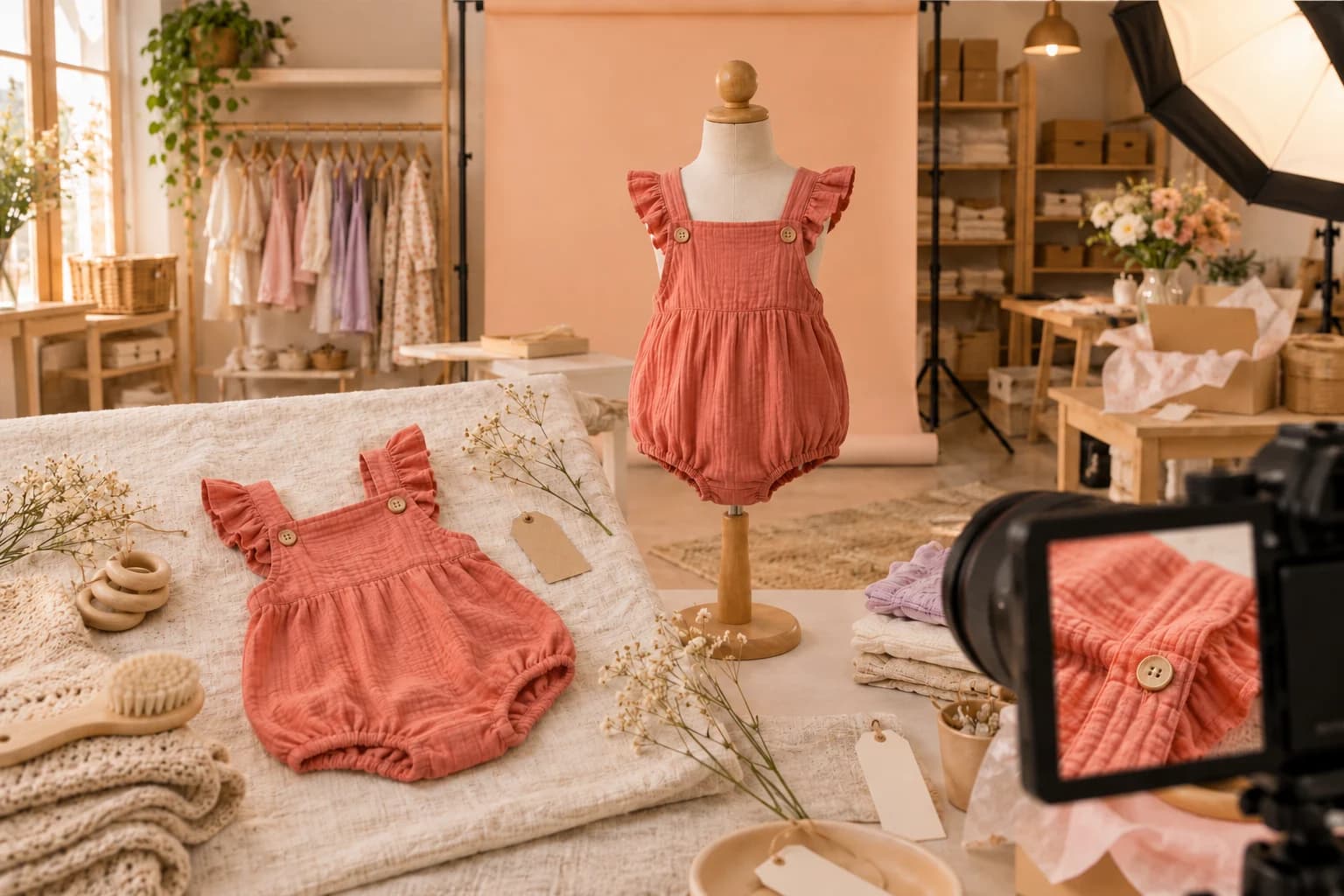
Originals remain available. The generation context carries saved product facts and size-derived age context. Colour, print, construction and details still need human review.
04 / Problems
The hard parts live between the garment, the record and the shelf. A missing field. An ambiguous action. A pile of stock that still needs putting away.
Study 01 records a regression. Studies 02–03 explain current design pressures. Study 04 connects the documented batch backend change to the current native flow.
Study 01
The photograph is clear. The structured answer is not. An empty suggested subcategory can still make an enrichment response invalid.
Optional means absent or null. A present suggestion needs useful content. Validate the whole result before applying it, and make recovery explicit.
The enrichment recovery regression tests explicitly cover subcategory.value = an empty string. The current contract rejects blank suggestions and supports a null subcategory.

Study 02
When someone is holding an item, a long inventory list asks the wrong question. They need that exact size, SKU and stock context.
Find & Scan begins with a scan or a search. The catalogue stays out of the way until the operator looks for something.
Current Find & Scan opens with an empty search state and resolves an exact variant before opening Item Actions.
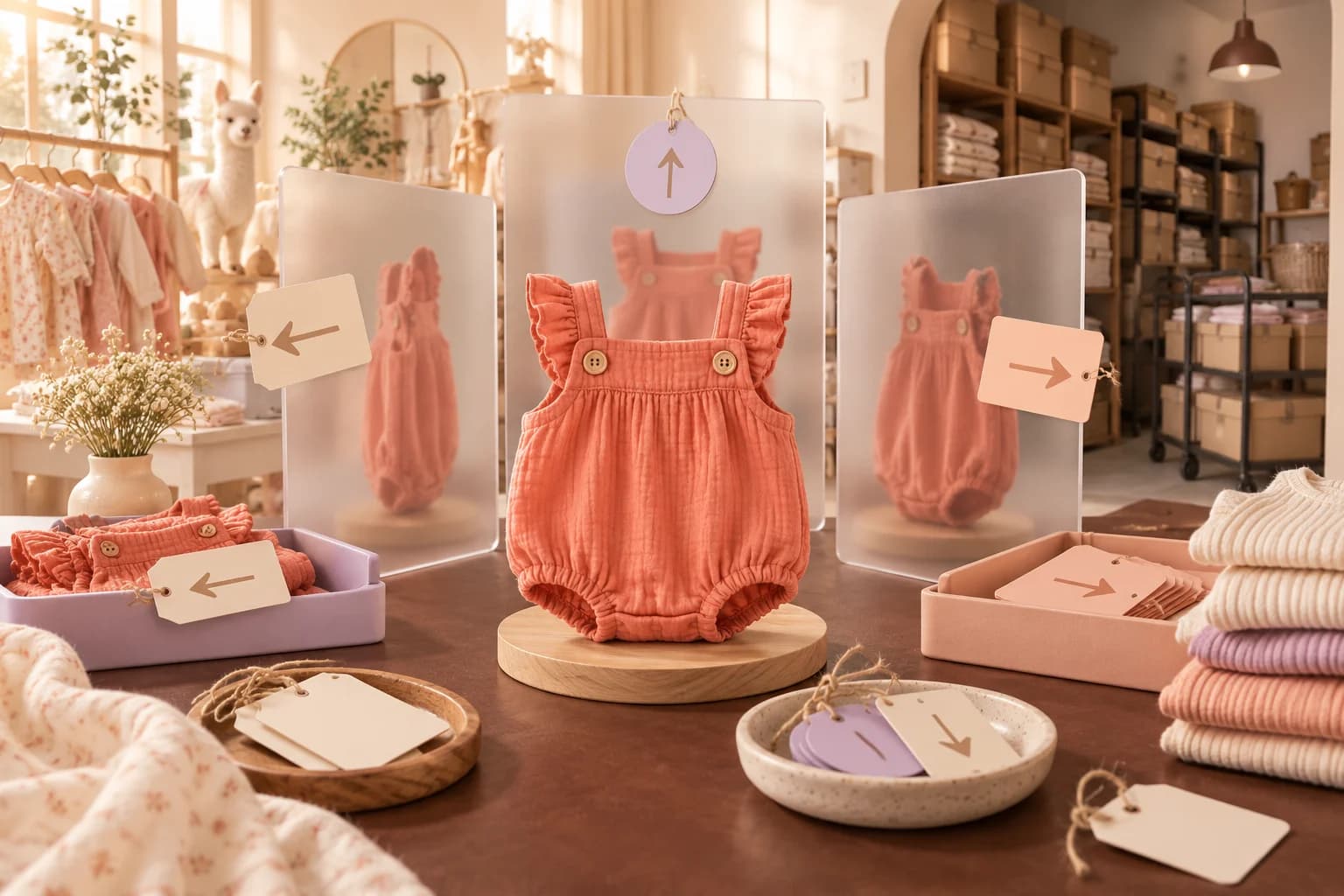
Study 03
A product is the shared idea. A variant is a particular size and colour. A stock allocation says how many live in a particular place. Their actions cannot all mean the same thing.
Keep product editing and publication at product level. Keep an exact item’s price, stock and movement attached to its variant and allocation.
Current Product Actions and Item Actions use distinct routes and action models. Publication from either surface explicitly changes the whole product.

Study 04
“Needs a Home” makes waiting stock visible. The work is getting it off the staging table and into a known location.
Scan a batch of items, scan one destination, review and confirm. If a response is lost, retry the same operation instead of moving the stock twice.
The batch Put Away backend commit adds an atomic movement. Current client tests cover changed stock, rejected scans and retrying an ambiguous response with the same operation identity.
05 / Solutions
Find the exact item. Give it the right action. Put it where it belongs. Keep the shop’s information in step with the physical world.
A problem list tells you what is waiting. A workflow helps you finish the job.

Structured product information powers search and approachable shopping questions. The customer sees the parts that help them choose.
Product editing, exact variants and physical allocations retain their own responsibilities. The model follows the garment into the stockroom.
AI content, photography and duplicate candidates support the shopkeeper. Useful suggestions still need a human decision.
Scan, accept, choose a destination and confirm. Sound distinguishes a read label from accepted stock.
The customer sees the clothes.
The system remembers the details.
06 / Evolution
Seven capabilities, brought into one connected operation. Each gives the small shop a little less work to carry.
Conceptual mutations of the system, rather than dated release milestones.
Mutation 001 / I
A lovely piece gets a place online.
Photography and useful product information turn a physical garment into a discoverable page.
Mutation 002 / II
Structure makes the collection findable.
Titles, brand, descriptions, tags, shopping facets and variants make a simple query useful.
Mutation 003 / III
The right size becomes an exact thing.
Each size and colour can carry its own SKU, stock, effective price and storage allocations.
Mutation 004 / IV
AI assists. The shopkeeper decides.
Structured suggestions help describe and classify the item while merchant facts stay authoritative.
Mutation 005 / V
The physical object opens the record.
Scanning bridges an item in the operator’s hands to its relevant actions.
Mutation 006 / VI
Every item can find its home.
A batch, a scanned destination and a reviewed movement connect physical storage to inventory.

Mutation 007 / VII
The pieces work as one operation.
The storefront, catalogue, identity, imagery and physical workflows share product truth. Website checkout and automatic postage-label purchase are not claimed as live features.